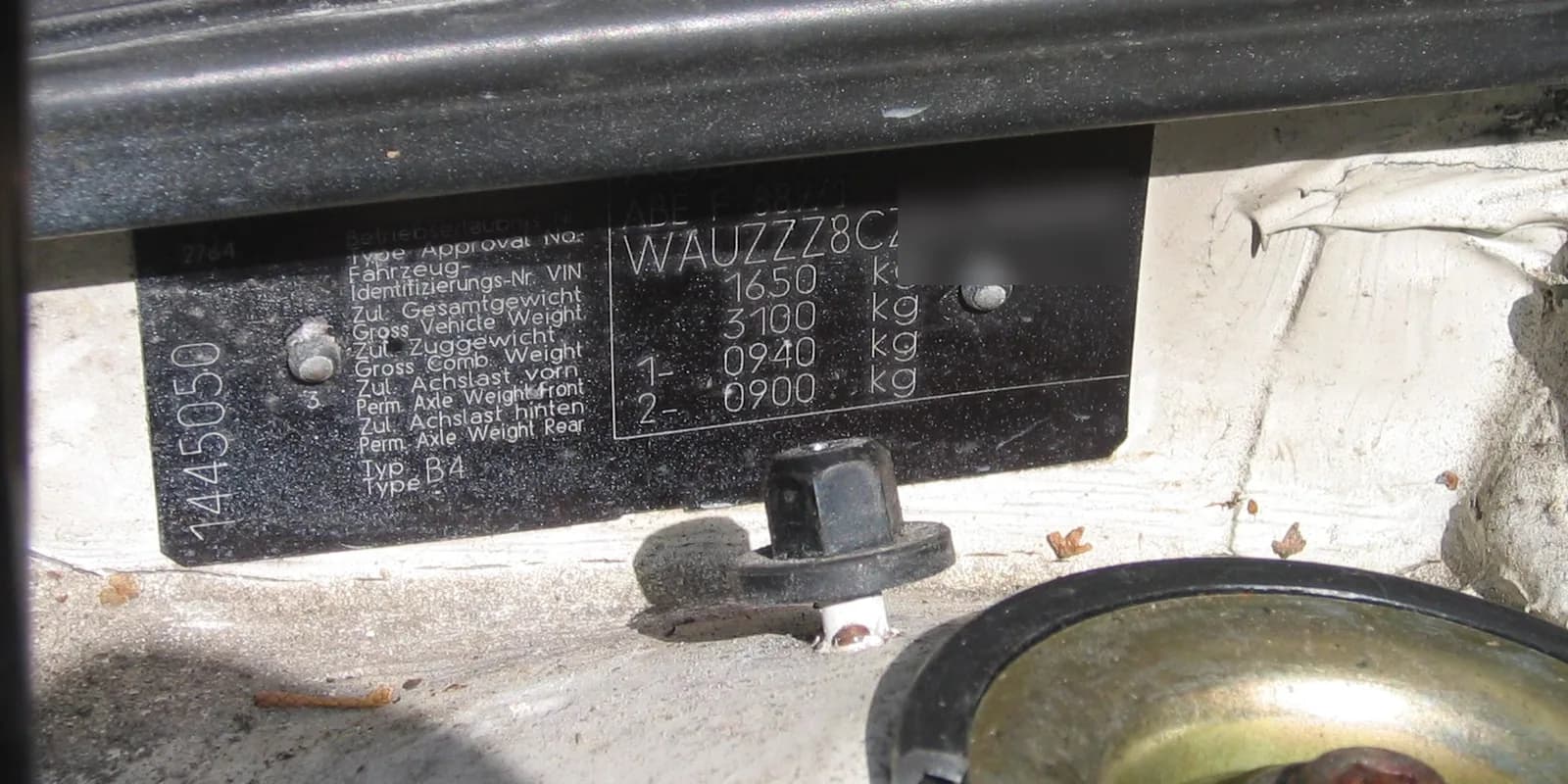
The VIN is in three places on the car
The VIN is behind the windscreen, on the driver's side, and on a plate on the driver's door pillar. The third one is under the bonnet. The exact place depends on the make: above the radiator grille, next to the shock absorber mount or on the top edge of the wall between the engine and the cabin.
The number is also in the papers. In the registration certificate it is on the back, under the letter E, and it is also on the insurance policy. On the car and in the papers it must be the same, character by character.
Also compare the make, model and number plates on the car with the registration certificate. More about checking a car before you buy
Check that the number has not been altered
Look at the plate and the stamped number in daylight. These are signs of tampering:
- The plate is held by screws instead of rivets.
- The rivets are loose or do not match.
- The number is scratched.
- There is glue, tape or paint over the number.
- A piece of metal is missing around the stamped number, or you can see welding.
If the numbers do not match or you see any of these marks, do not buy the car and do not pay a deposit.
The number on the car can also be altered so that the eye cannot see it. It happens that a stolen car is found only when the new owner takes it to an authorised dealer service and the car is connected to their system. The car is then seized and returned to the real owner. The buyer is left without the car and can claim the money only from the seller.
So also compare the number with the one written into the car's computer. On cars that keep the VIN in the computer, diagnostics reads it. This shows whether it is the same as on the plate and in the registration certificate, and you find out before you pay.
What a VIN decoder shows
Each part of the number says something about the car. An online decoder reads it for you. It is a free website: you enter the VIN and it shows what the number means. You find one by typing “VIN decoder” into Google.
| Characters | What they say |
|---|---|
| 1 to 3 | Maker and country. For example, WVW is Volkswagen from Germany. |
| 4 to 9 | Description of the car: model, body and engine, in the maker's code. |
| 10 to 17 | The code of that exact car. On cars made for America, the 10th character is the model year and the 11th the factory. |
The letters I, O and Q are not used in a VIN, so they are not confused with 1, 0 and 9. When you type the number into a decoder, type a zero instead of the letter O and a one instead of the letter I.
A decoder shows the maker, model and year, and for some cars the basic equipment too. How much it shows depends on the car. It shows the most for a car built for the US market, because there the maker must report to the state what each character in the number means. If this does not match the ad or the registration certificate, ask the seller why.
With the car maker, the VIN can be used to check whether the colour, engine and equipment match the car. Some makers also show on their website, by VIN, whether the car was recalled to the service because of a fault in the model.
You read the model year from the 10th character
On cars made for America, the 10th character is always the model year. European makers do not have to follow this rule. Some use the 10th character for the year and some do not. So check the year of a European car with a decoder, not only by the 10th character.
For models from 2001 to 2009 that character is a digit: 1 is 2001 and 9 is 2009. From 2010 they are letters:
A = 2010, B = 2011, C = 2012, D = 2013, E = 2014, F = 2015, G = 2016, H = 2017, J = 2018, K = 2019, L = 2020, M = 2021, N = 2022, P = 2023, R = 2024, S = 2025, T = 2026, V = 2027.
The model year is not always the year of manufacture. A new model year often starts as early as August or September of the year before, so a car built in the autumn can carry the code of the following year.
A paid report shows part of the history
A paid report is ordered online, by VIN. It collects records from databases in several countries. It can include:
- Mileage recorded at inspections and services, so you can also see whether it was rolled back.
- Theft reports from the police.
- Damage, sometimes with photos after an accident.
- Registration and inspection dates.
- Whether the car was a taxi or a rental car.
- Which country the car comes from.
How much data a report has depends on the car and on the databases it covers. An empty report means there are no records, not that the car is clean.
Look for data in the report that does not match: a different fuel from the one the car uses, or the car registered in two places at the same time.
The European Parliament cites estimates that the mileage has been rolled back on 30 to 50% of cars sold from one country to another. It also says this harms countries that import used cars from the European Union. So compare the mileage on the clock with the report and with diagnostics. More about checking the mileage
Use the VIN to check for a pledge too
A car can be pledged for a loan or a debt. Whoever buys a pledged car buys it together with the pledge, so someone else's debt can be collected from that car.
The Pledge Register is kept by the Business Registers Agency (APR), and its data is public. On the APR website, in the search by pledged item, enter the VIN, then the plates, because the search only finds a pledge by the data that was registered. You can also ask for a certificate that no pledge is registered on the car. More about pledges and checking the seller
The VIN does not tell you what the car is like today
The VIN tells you how the car was built and part of its history. What the car is like today is shown by diagnostics and an inspection before you buy.
Diagnostics sees only what the car's computers have recorded. Worn brakes, noise from the suspension or an oil leak show up only in an inspection. So also take the car for a test drive.
Have diagnostics done before the deposit, while you have paid nothing yet.
What you find out: depends on the check
- Free VIN decoder: the maker, model and year, for some cars the basic equipment.
- Paid report: part of the history, the mileage, theft reports and damage, if the databases have them.
- Looking at the car: whether the number has been altered.
- Diagnostics: what the car is like today, and the number from the computer when the car keeps it.