When chains are mandatory
From 1 November to 1 April, when there is snow, ice or black ice on the road, a car must have winter tyres and chains for at least two driven wheels. In built-up areas chains do not have to be in the car. Instead of chains, the rulebook also accepts other devices that give the wheel better grip.
You fit chains where there is a blue round sign with a wheel and chain, if there is snow on the road. Without that sign you may fit chains only when the road is covered in snow. A driver who has no winter equipment or doesn't use it properly pays a fine of 5,000 dinars, and the police can order them to fit chains before going on. More about what the law requires in winter
Which wheels chains go on
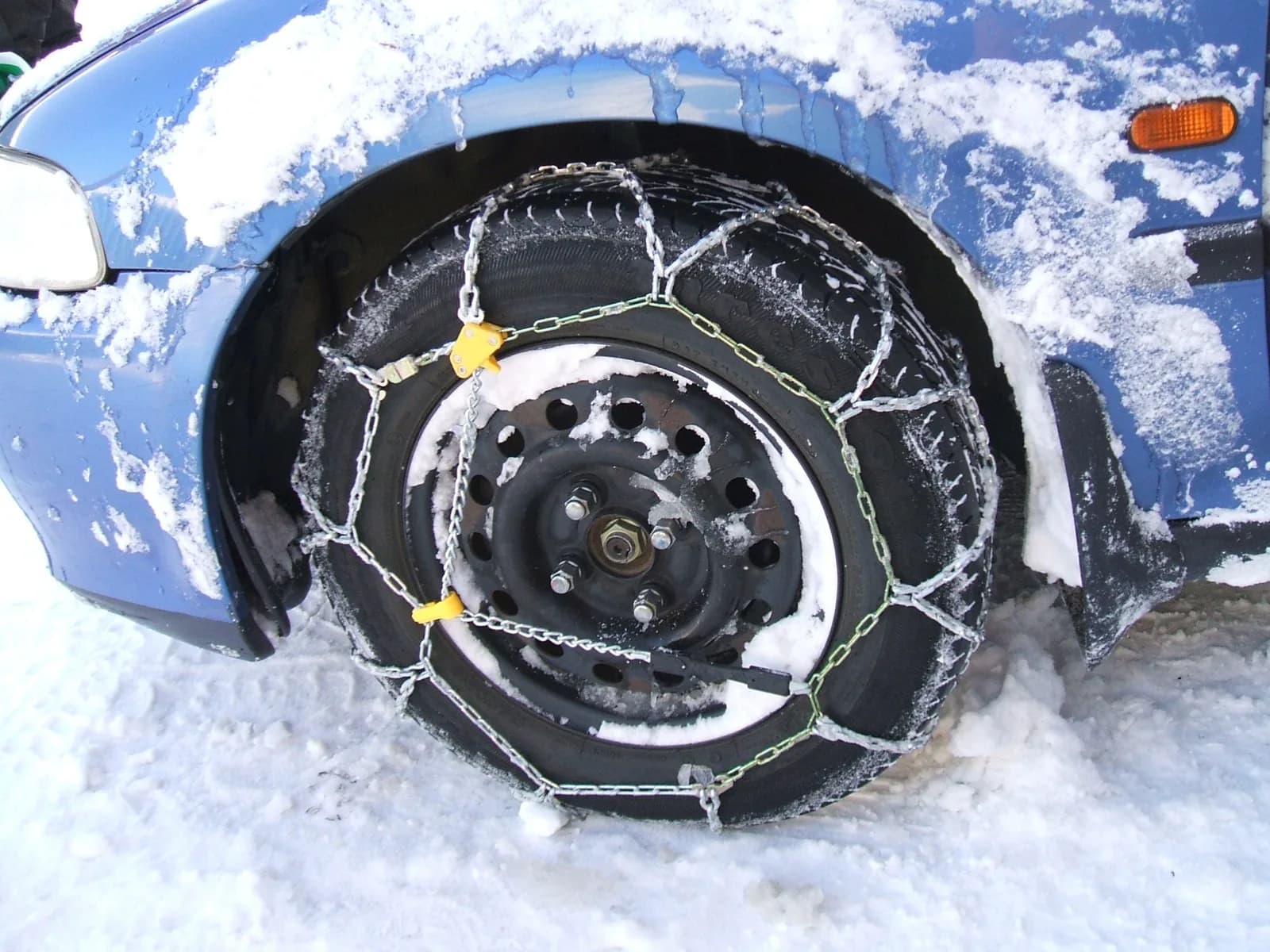
Chains go on the wheels driven by the engine, on both wheels of the same axle.
Which wheels: depends on the drive
- Front-wheel drive: chains go on the front.
- Rear-wheel drive: chains go on the rear.
- Four-wheel drive: on at least one axle. Which one is in the owner's manual. Some cars require chains only at the rear.
A car with chains only at the front is more likely to slide out at the rear in a bend, and a car with chains only at the rear is more likely to carry on straight when it should turn. So on snow with chains drive slowly, especially in bends.
How to choose the size of chains
Before buying, check the tyre size. It is on the side of the tyre, for example 205/55 R16. Chains are sold by tyre size, and one chain model usually fits several sizes. The pack says which tyres the chains are for.
Not every tyre approved for your car can take chains. On some cars chains don't fit the larger wheels, because a tyre with a chain doesn't have enough room in the wheel arch. So before buying, check in the owner's manual whether your car may take chains, on which tyres and how thick.
- 9 mm chainsTake up little room around the wheel. For cars with little space between the tyre and the wheel arch or suspension.
- 12 mm chainsFor cars with enough room around the wheel.
- 16 mm chainsFor larger cars, off-roaders and vans.
Any chains can go on alloy wheels, but the chain and its fastener must not rub the rim. The more the rim sticks out beyond the side of the tyre, the greater the risk of the chain scratching it.
Ordinary metal chains are the best. Plastic chains exist, but metal ones grip better and last longer.
How to fit snow chains, step by step
Fit the chains for the first time at home, in the dry and in daylight. On snow, in the dark and with cold hands it is much harder. Follow the instructions in the box, because chains differ. In general:
- Stop on a level place, off the road. Turn on the hazard lights, put on the vest, and on a blind stretch set up the warning triangle.
- Switch off the engine and apply the handbrake. Keep the car key with you.
- Clear the snow around the wheel. Don't jack the car up at the roadside.
- Lay the chain out in front of the wheel so it doesn't get tangled.
- Pass the chain behind the wheel and join it at the top of the tyre, on the inner side.
- Connect the chain on the outer side as well and tighten it as the instructions say.
- Move the car a few metres so the chain settles on the tyre.
- After 50 to 100 metres stop and check the chains. Tighten them again, even if they are self-tensioning.
In the owner's manual also check whether traction control should be switched off with chains or whether the car has a special mode for driving with chains.
Driving with chains
- Don't drive faster than 50 km/h. That is what Serbia's Road Traffic Safety Agency recommends.
- Don't brake or accelerate suddenly. Even with chains a car on snow takes longer to stop than on a dry road.
- On a longer trip, stop now and then to check the chains, even when all is quiet.
- Take the chains off as soon as you reach a road without snow. On asphalt chains wear quickly, damage the road and the car brakes worse.
When a chain starts banging, stop and check it. Take a broken chain off straight away, because a loose end hits the car.
What chains can damage
A loose chain hits the parts behind the wheel: the brake hose, the ABS sensor cable, the suspension, the wheel arch and the rim. A chain that is too tight can break. A tyre with a chain is wider, so a chain of the wrong size can touch the bodywork, suspension or brakes even when it is properly tightened.
If the ABS light is on after driving with chains, read what it means. More about the ABS light
Chains or snow socks
Snow socks are textile covers pulled over the tyre. They are easier to fit and take up little room. The rulebook doesn't name them, but it accepts "other devices that increase traction", and Serbia's Road Traffic Safety Agency has listed socks as an option alongside chains.
| Chains | Socks | |
|---|---|---|
| Fitting | Harder, needs practice | Easier and quicker |
| Moving off on snow | Good | Just as good |
| Fresh snow and ice | Grip better | Grip less |
| On a dry road | Wear and damage the road | Tear quickly |
| Little room around the wheel | Only thin ones or none | Often possible |
| In Austria, where a sign requires chains | Valid | Not valid |
In a test by the Austrian motoring club ÖAMTC, socks pulled away on snow as well as chains, but after at most 50 km of dry road they were so worn that in places the surface was no longer whole. So chains are more reliable when you drive on snow for a long time.